
Blog
Orderly Liquidation Value vs. Fair Market Value: Which Equipment Appraisal Fits your Situation?
Equipment appraisals rest on three different value premises: fair market value, orderly liquidation value, and forced liquidation value, and each one produces a different number for the same asset. This guide explains when lenders, courts, and bankruptcy trustees require each premise so you can order the right report the first time.
When you request an equipment appraisal, the number on the last page depends on more than the machine's condition and age. It depends on which premise of value the appraiser was asked to use. Fair market value, orderly liquidation value, and forced liquidation value are three distinct, professionally recognized standards, and they can produce meaningfully different conclusions for the exact same forklift, CNC machine, or fleet of tractors.
Ordering the wrong premise wastes money and can delay a loan, a court filing, or a bankruptcy proceeding while a new report gets scoped. Our desktop equipment appraisal team gets asked to explain this distinction on nearly every intake call, so this guide walks through each premise, what it's built for, and how to self-identify which one your situation actually requires.
What Is Fair Market Value in an Equipment Appraisal?
Fair market value (FMV) is the price at which equipment would change hands between a willing buyer and a willing seller, with neither party under any compulsion to act and both having reasonable knowledge of the relevant facts, as of a specific date. It is the highest of the three premises because it assumes normal market exposure: the seller can wait for the right buyer, and the buyer isn't forced to close on a deadline.
This is the standard that governs most non-distressed equipment transactions, and professional definitions of value maintained by the American Society of Appraisers place FMV at the top of the value hierarchy for exactly this reason.
FMV is the right premise when:
- Two independent parties are negotiating an arm's-length sale of equipment, such as a business buying a competitor's production line or a farmer purchasing tractors from a neighboring operation.
- A divorce or estate matter requires equitable distribution of jointly owned equipment, since courts generally want a value that reflects what the asset is genuinely worth to a normal buyer, not a distressed one.
- A charitable donation of equipment is being reported to the IRS, since the deduction is based on what a willing buyer would pay, not a liquidation figure.
- A gift or estate tax filing needs to establish the equipment's value for reporting purposes.
Example: A dairy operation is dissolving a 50/50 partnership and needs to split the value of its milking equipment and tractors. Because neither partner is under pressure to sell quickly, the appraiser uses fair market value, reflecting what each machine would fetch with normal marketing time and a motivated but unhurried seller.
What Is Orderly Liquidation Value, and Why do Lenders Ask for It?
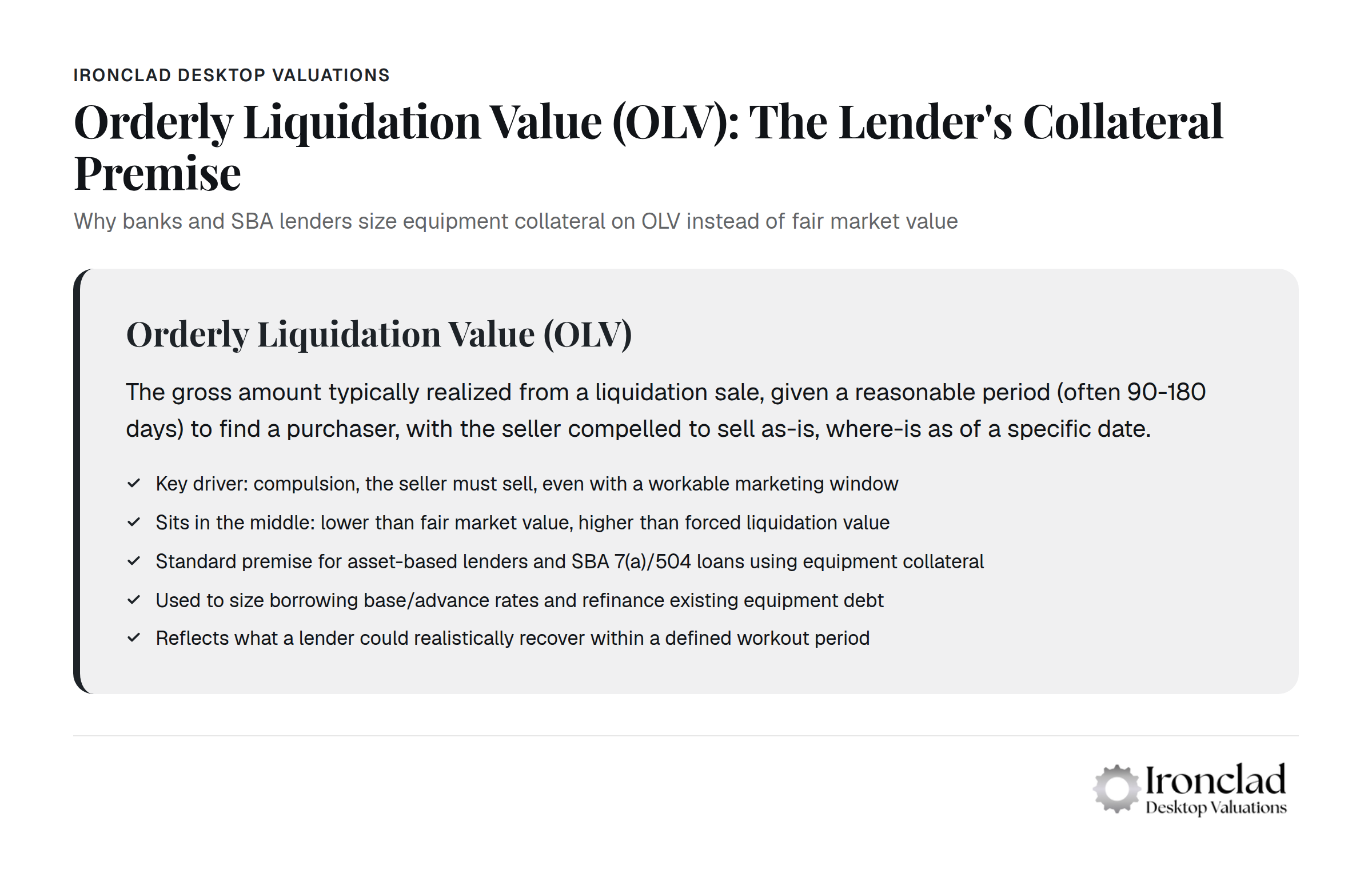
Orderly liquidation value (OLV) is the gross amount that could typically be realized from a liquidation sale, given a reasonable period to find a purchaser, with the seller compelled to sell on an as-is, where-is basis as of a specific date. The key difference from FMV is compulsion: the seller must sell, even though there's still a workable window, often cited in industry practice as roughly 90 to 180 days, to market the equipment properly.
OLV sits in the middle of the three premises. It's typically lower than fair market value because the compressed timeline and the buyer's awareness of the seller's situation both pull the price down, but it's higher than forced liquidation value because there's still time to reach the right buyers instead of dumping everything at a single auction event.
This is the premise most asset-based lenders and SBA-guaranteed loan programs actually rely on when equipment is pledged as collateral. Lenders don't care what a machine would fetch under ideal, unhurried conditions; they care what they could recover if they had to liquidate the collateral within a defined workout period. That's why a bank or SBA lender underwriting an equipment-backed loan will typically request an equipment appraisal for loan collateral scoped specifically to orderly liquidation value rather than fair market value.
OLV is the right premise when:
- A lender is sizing a borrowing base or collateral advance rate for an asset-based loan secured by machinery, vehicles, or production equipment.
- A business is refinancing existing equipment debt and the new lender requires a fresh liquidation-based valuation.
- A company is planning a wind-down or divestiture on a defined timeline, such as closing a facility over the next two quarters.
- An SBA 7(a) or 504 loan application includes equipment as part of the collateral package.
Example: A manufacturer is pledging its CNC machines and material handling equipment for a $2 million asset-based line of credit. The lender's collateral requirements call for orderly liquidation value, since that number reflects what the bank could realistically recover if the borrower defaulted and the equipment had to be sold within a normal workout window rather than at negotiated, unhurried prices.
What Is Forced Liquidation Value, and When Does Bankruptcy Require It?
Forced liquidation value (FLV) is the gross amount that could typically be realized from a properly advertised and conducted public auction, with the seller compelled to sell with a sense of immediacy on an as-is, where-is basis. It is the lowest of the three premises because the timeline collapses to days or weeks rather than months, and the sale method is usually a single auction event rather than a marketed sales process.
FLV assumes real urgency: a court deadline, a foreclosure, or a trustee who needs cash fast. It's important not to assume every auction result equals forced liquidation value; a well-attended, properly advertised auction for desirable equipment can sometimes land close to fair market value. But when the sale is compelled and the timeline is compressed, FLV is the honest floor for what the equipment will bring.
FLV is the right premise when:
- A company is in Chapter 7 or Chapter 11 bankruptcy and a trustee needs to know the minimum recoverable value of equipment assets for the estate.
- A secured creditor is repossessing and auctioning off collateral after a default, with no ability to wait for a better market window.
- A court has ordered a sale within a fixed, short deadline, such as ten or thirty days.
- An emergency wind-down is underway, for example after a lease default or a sudden facility closure.
When equipment is part of a bankruptcy estate, our equipment appraisal for bankruptcy service is built around exactly this premise, giving trustees and creditors a defensible floor value that reflects the real conditions of a forced, time-pressured sale.
Example: A manufacturer files Chapter 7 and the trustee has 30 days to liquidate the shop floor. The appraiser applies forced liquidation value because the sale must happen through a single, properly advertised public auction on a hard deadline, not through a negotiated, multi-month sales process.
Comparing the Three Value Premises Side by Side
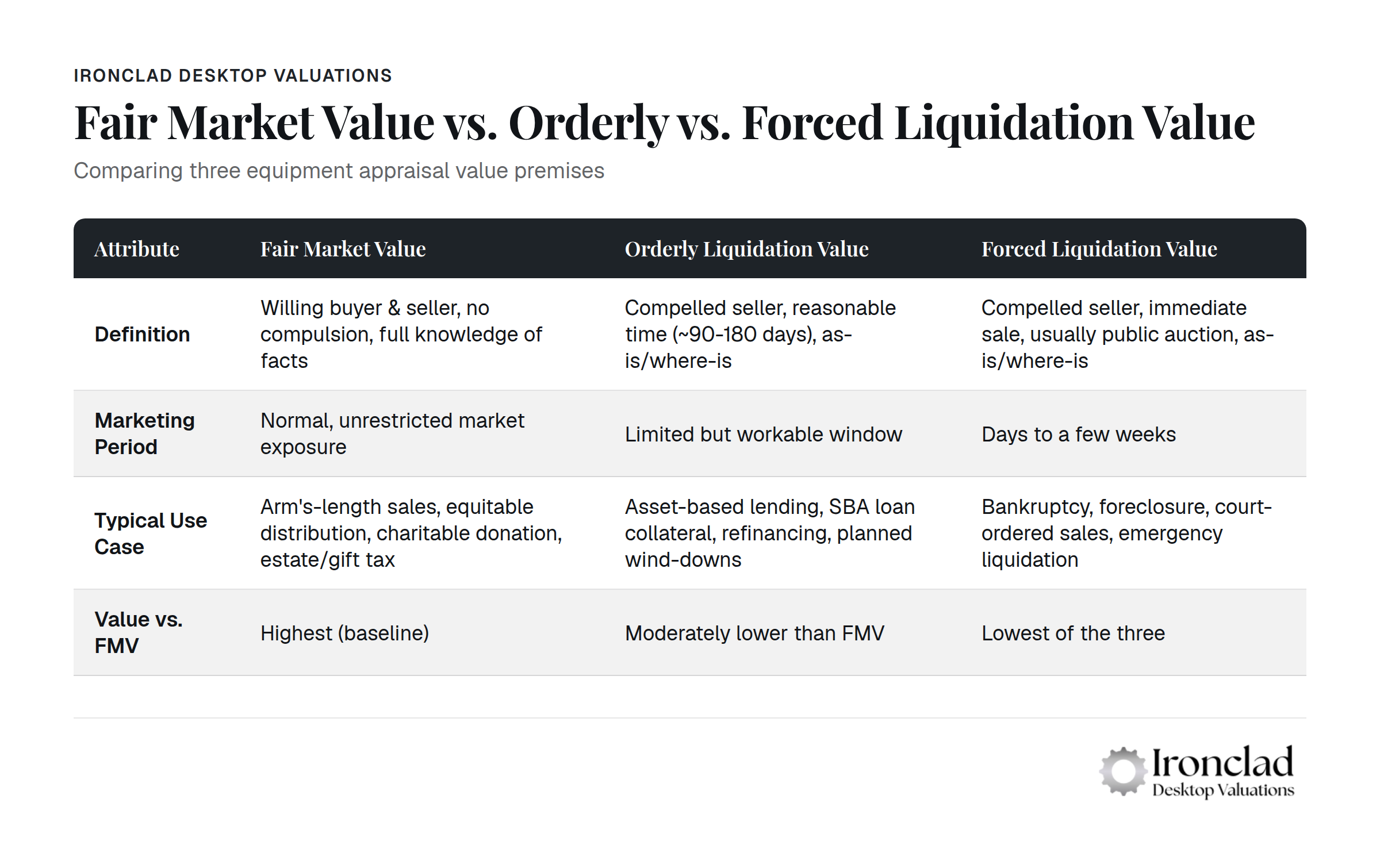
The table below summarizes how the three premises differ in definition, timeline, use case, and expected value relative to fair market value.
| Value Premise | Definition | Typical Marketing Period | Typical Use Case | Value Relative to FMV |
|---|---|---|---|---|
| Fair Market Value | Willing buyer, willing seller, no compulsion, reasonable knowledge of facts | Normal, unrestricted market exposure | Arm's-length sales, equitable distribution, charitable donations, estate and gift tax | Highest (baseline) |
| Orderly Liquidation Value | Compelled seller, but reasonable time (often ~90-180 days) to find a buyer, as-is/where-is | Limited but workable window | Asset-based lending, SBA loan collateral, refinancing, planned wind-downs | Moderately lower than FMV |
| Forced Liquidation Value | Compelled seller, immediate sale, typically via public auction, as-is/where-is | Days to a few weeks | Bankruptcy, foreclosure, court-ordered sales, emergency liquidation | Lowest of the three |
Which Report Should You Order?
The fastest way to identify the right premise is to ask who needs the number and why. If you're negotiating a sale, settling a divorce, or filing a charitable donation, you need fair market value. If a lender is underwriting collateral, you need orderly liquidation value. If a court, trustee, or creditor needs a defensible floor under time pressure, you need forced liquidation value.
Watch out: Ordering a fair market value report when your lender actually requires orderly liquidation value is one of the most common (and costly) mistakes borrowers make. The lender will reject the report and require a new one scoped correctly, adding weeks to a financing timeline.
Pro tip: If you're not sure which premise your lender, court, or trustee requires, ask them directly before requesting the appraisal. Loan documents, court orders, and bankruptcy filings usually specify the premise by name.
Equipment appraisal fees are quoted as a fixed fee after the assignment is scoped, never billed hourly. For machinery and equipment appraisals, standard reports typically start at $295, with IRS-qualified or advanced-scope reports starting at $395; most engagements run $695 to $3,000 depending on the number of assets, the intended use, and the depth of analysis required, with the most complex multi-site or high-value fleets running $5,000 to $10,000 or more. The premise of value you need doesn't change what the appraisal costs; it changes the number the appraisal concludes.
Getting the Right Premise on the First Try
Fair market value, orderly liquidation value, and forced liquidation value all describe the same asset under three different sets of assumptions about time and compulsion. Choosing correctly the first time keeps a loan closing on schedule, keeps a bankruptcy estate on track, and keeps a divorce or estate matter from stalling over a mismatched report.
If you're not certain which premise your situation calls for, our team can review your loan documents, court order, or transaction details and scope the correct report before work begins.
This article is provided for general informational purposes only and does not constitute legal, tax, or financial advice. Readers should consult a qualified attorney or CPA regarding their specific circumstances.